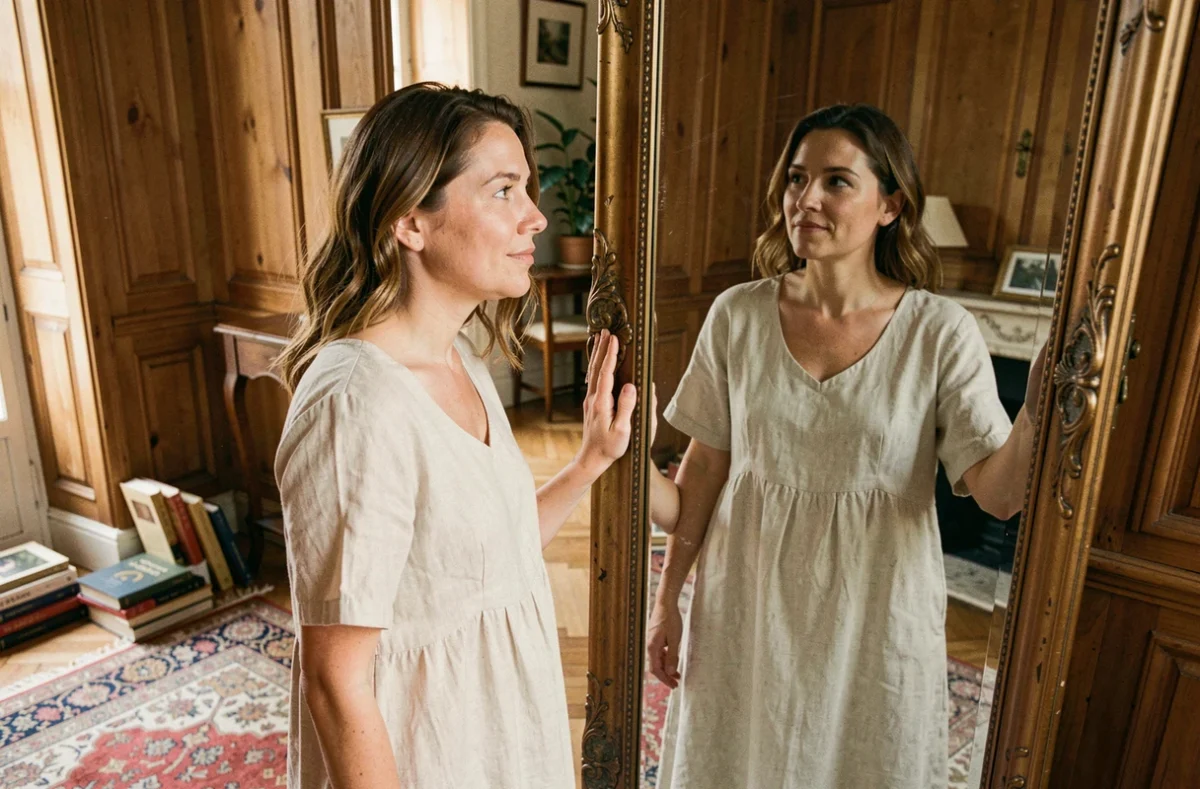
When choosing a photo for an online profile, we unknowingly apply specific beauty criteria: framing of the face, lighting, symmetry. This mundane act reveals how much our perception of beauty influences our daily decisions, far beyond museums or fashion shows. Beauty, as a concept, intertwines biological mechanisms, cultural legacies, and, recently, algorithmic filters that reshuffle the deck.
Beauty and Digital Transparency: What the French Law of 2023 Changes
Before discussing aesthetics or philosophy, we can start from a concrete fact. Law No. 2023-451 of June 9, 2023, regulates commercial influence in France. It requires the disclosure of retouched images altering the silhouette or face, as well as content generated or modified by artificial intelligence.
This obligation transforms beauty into a matter of loyalty to the public. A face smoothed by a filter is no longer just an aesthetic choice; it is a commercial message that must be identified as such. For content creators, this means rethinking how they present bodies and faces.
This touches on a rarely addressed point in beauty debates: the regulatory dimension. When the state legislates on what can be shown as “beautiful” without warning, it acknowledges that the perception of beauty is manipulable on a large scale. The reflection on the definition of beauty on Belle et Épanouie then takes on a very concrete dimension, rooted in digital everyday life.

Proportion and Harmony: Measurable Criteria of Beauty
In the history of art, beauty has never been purely subjective. The Greeks used ratios of proportion to sculpt bodies. Facial symmetry, balance of volumes, the ratio between the torso and limbs: everything was calculated.
These criteria have not disappeared. We find them in modern architecture, in object design, in photographic composition. Visual harmony relies on geometric ratios that our brain identifies even before we are aware of it.
However, reducing beauty to proportion would be a mistake. Twentieth-century art systematically broke these rules. Cubism distorts faces, raw art rejects symmetry, fashion photography plays with lighting that deepens shadows. What fascinates in these works is precisely the tension between expected harmony and the proposed rupture.
What Nature Teaches About Aesthetics
The spirals of a seashell, the branching of a tree, the arrangement of petals in a flower follow mathematical logics. Natural beauty is not random. Our attraction to certain landscapes or organic shapes is partly explained by this underlying regularity.
The natural world remains the primary aesthetic reference in most cultures, even when human beauty standards vary from one century or continent to another.
Social Media and Body Dissatisfaction: The Real Mechanism
It is often said that social media degrades self-image. Recent studies nuance this observation. It is not the time spent online that poses a problem, but the type of practices adopted.
Three mechanisms are more regularly associated with body dissatisfaction:
- Physical comparison with idealized content (retouched photos, face filters, staged bodies)
- Systematic retouching of one’s own photos before publication, creating a gap between the perceived image and the real reflection
- Active search for aesthetic validation, such as counting likes on selfies or soliciting opinions on appearance
These specific behaviors are far more predictive than the simple number of hours spent on an app. The distinction is useful because it shifts responsibility: the problem is not solved by limiting screen time, but by changing the nature of the interaction.
Differentiated Effects According to Audiences
Recent research also documents that the impact varies by groups. Black teenage girls, for example, face aesthetic norms that often reflect Western standards (light skin, straight hair, slimness). The psychological consequences of this exposure are often underestimated.
This observation relates to a technical problem. Artificial intelligence tools can homogenize beauty criteria when their training data insufficiently represents the diversity of faces and skin tones. A recommendation algorithm trained primarily on photos that meet European standards ends up favoring those same standards in its suggestions.
Art, Body, and Concept of Beauty Through the Ages
The beauty of a woman in the Middle Ages had nothing to do with that valued in the eighteenth century. The works of each era document these shifts. The rounded bodies of Rubens, the elongated silhouettes of Modigliani, the geometric faces of Picasso each tell a different conception of beauty.
What remains constant is that each era believes it holds the correct definition. The aesthetics of a given century always seem natural to those who live it. It is historical hindsight that reveals how constructed these criteria were.
- Greek antiquity valued proportion and physical virtue as a reflection of moral virtue
- The Renaissance associated bodily beauty with technical mastery of representation
- The modern era introduced the idea that beauty could arise from rupture, disturbance, and embraced imperfection
Kant posited that beauty is “that which pleases universally without a concept.” This formulation remains useful because it points to a shared experience: we recognize beauty before we can explain it. Responses vary on this point, but this immediacy of aesthetic judgment seems to transcend cultures.
Beauty is neither a luxury nor an abstraction. It structures our clothing choices, our living spaces, our digital interactions, our reactions to a landscape or a work. Understanding its mechanisms, from Greek proportion to algorithmic biases, allows us to look differently at what we find beautiful, and above all, to ask ourselves why.