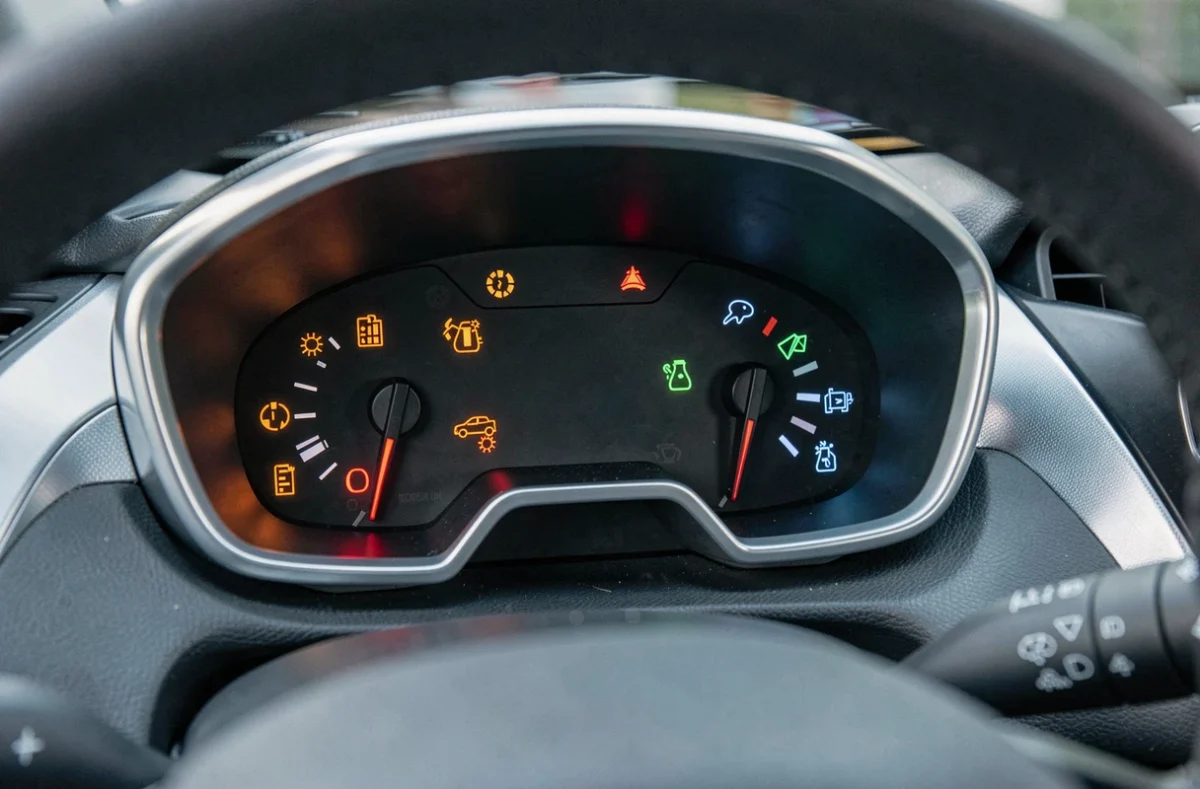
On a Peugeot 208, the color of a warning light is not always enough to determine the appropriate action. The same orange icon can indicate either a simple maintenance reminder or an active degradation of the catalyst, depending on whether it is steady or flashing. The vehicle’s generation, type of engine, and date of first registration also affect the dashboard reading. Here, we detail the technical points that general guides rarely address.
Orange engine light on Peugeot 208: steady or flashing, two distinct diagnoses
A steady orange engine light often leads to a simple appointment at the workshop. The reflex is correct but incomplete. A flashing engine light indicates active combustion misfires, which can damage the catalyst within a few dozen kilometers.
In this case, the procedure recommended by Peugeot in the 208 user manual (2020 edition) is to immediately reduce engine load: ease off the accelerator, avoid hard accelerations, and reach a control point without delay. Continuing to drive normally while thinking that an orange light allows for continuation of the journey is a common misreading.
To find the list of dashboard warning lights for the Peugeot 208 along with their associated icons, we recommend cross-referencing this resource with the official guide corresponding to your edition period.
On 208s equipped with the PureTech 1.2 engine with a timing belt immersed in oil (units produced before June 2022), an engine light may be related to the distribution system and not to pollution control. A drop in oil pressure directly affects the lubrication of the belt, which radically changes the priority of intervention. Stellantis has also launched targeted warranty extension campaigns for these engines, with eligibility depending on the VIN and production date.

Differences in warning lights between 208 I, 208 II, and e-208
We regularly observe confusion related to the coexistence of multiple generations in the fleet. The official Peugeot guide, accessible via Service Box, emphasizes the need to select the vehicle silhouette and the edition period corresponding to the date of first registration. The icons, associated messages, and procedures are not interchangeable.
Specific warning lights for the electric e-208
The alerts of the e-208 do not read like those of a thermal 208. The indicators related to the traction battery, charging, and high-voltage circuit have no equivalent in gasoline or diesel versions. An orange light representing a charging plug, for example, may indicate a communication fault between the onboard charger and the charging station, not a mechanical problem.
Red warning lights remain critical across all versions, but their origin differs. On an e-208, a red temperature light does not concern the engine coolant in the classical thermal sense: it may indicate overheating of the battery pack or power electronics. The reaction (immediate stop, ignition off) remains the same, but the workshop diagnosis takes a completely different path.
208 I versus 208 II: notable evolutions
The 208 II introduced a digital display that shows text messages in addition to icons. On the 208 I, the driver only has the warning light, without contextual precision. This difference makes knowledge of the symbols even more critical for owners of the first generation.
Red warning lights on Peugeot 208: prioritizing emergencies
All red warning lights require stopping, but not within the same timeframe. We distinguish two categories in the workshop.
- Immediate stop, engine off: engine oil pressure (symbol of a can), coolant temperature at maximum, brake system fault (if the handbrake is released and the light persists). For these three alerts, every additional kilometer exponentially worsens the damage.
- Stop as soon as possible, in a safe place: battery light (alternator fault, the vehicle is running on reserve power), power steering light (driving remains possible but requires increased physical effort at the wheel).
- Informative red lights without required stop: seatbelt unbuckled, door or trunk not closed properly. The icon is red to attract attention, but the situation does not damage any mechanical components.
Confusing these categories can be costly. Driving with an oil pressure light on for a few minutes can cause engine seizure. Conversely, stopping urgently on a highway for a seatbelt light creates unnecessary road danger.
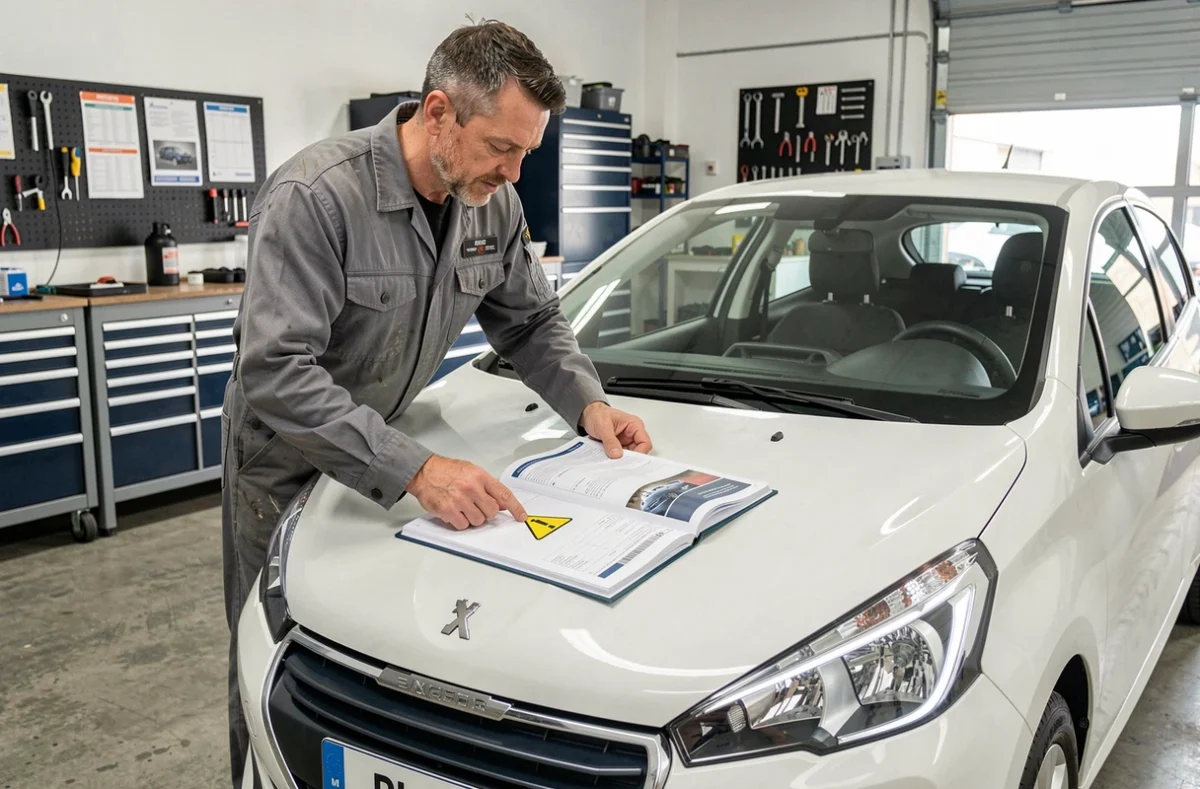
Orange or yellow light on Peugeot 208: the pitfalls of color coding
The orange/yellow color code encompasses very heterogeneous situations. A tire pressure light and a pollution control light share the same color but not the same urgency.
The TPMS (tire pressure monitoring system) light may illuminate simply due to an external temperature variation. A recalibration after manual verification of pressures is sufficient in most cases. The pollution control light, on the other hand, indicates an active fault in engine management that requires reading the fault codes via an OBD diagnostic tool.
Another common pitfall: the service light (wrench icon). It lights up at scheduled intervals and does not indicate any malfunction. It simply signals that the maintenance deadline is approaching or has passed. Confusing it with an engine fault generates unjustified workshop visits.
Electronic diagnostics remain the only reliable means of interpreting a persistent orange light. The color indicates the alert level, the fault code indicates the cause. Without OBD reading, any interpretation remains a hypothesis.
On the affected PureTech 208s with wet belt issues, we recommend never ignoring an orange light accompanied by a knocking noise on cold start. This combination may indicate belt elongation, a situation that justifies prompt intervention before breakage.